
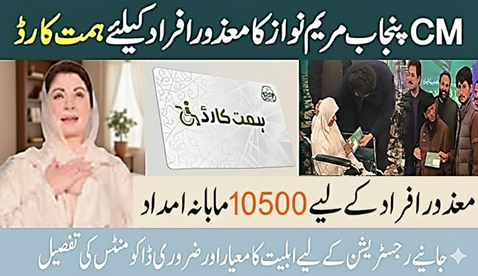
The CM Punjab Himmat Card 2026 is a major social welfare initiative by the Punjab government designed to provide consistent financial stability to the elderly, persons with disabilities, and low-income families. Managed by the Punjab Social Protection Authority (PSPA), the program focuses on uplifting marginalized groups by strengthening the provincial social safety net.
In addition to the standard stipend, certain NFSG (Non-Functional Support Group) categories receive Rs. 7,500. For the primary beneficiaries, the Rs. 10,500 grant serves as a vital lifeline, specifically intended to cover essential costs like food, medical treatments, and utility bills. By providing a reliable financial cushion, the Himmat Card protects the dignity of those unable to work and ensures their basic needs are met without constant financial stress.
Detailed Eligibility Criteria (2026)
To ensure that funds reach the most vulnerable citizens, the Punjab government has established the following strict requirements:
- Residency: Applicants must be permanent residents of the Punjab province.
- Demographics: Must be a senior citizen (65+ years old) or an individual with a disability certificate issued by the Punjab Social Welfare Department.
- Financial Status: Household income must fall below the official poverty line. This is generally verified via a Proxy Means Test (PMT) score of 37 or lower.
- Exclusivity: Applicants cannot be active beneficiaries of other government welfare programs, such as BISP, Zakat, or Bait-ul-Mal.
- Employment: The applicant must not be employed in the formal sector (government or private).
Stipend Breakdown
| Category | Amount | Frequency | Purpose |
| Standard Beneficiary | Rs. 10,500 | Quarterly | Food, Health, & Utilities |
| NFSG Category | Rs. 7,500 | Quarterly | Basic Financial Support |
Applying for the Punjab Himmat Card has been streamlined through a digital process, allowing Persons with Disabilities (PWDs) to register from the comfort of their homes without the need for frequent office visits.
Required Documents for Registration
The following documents are mandatory for a successful Himmat Card application:
- Original CNIC: A valid, non-expired Computerized National Identity Card.
- Disability Certificate: For PWD applicants, a formal certificate issued by the Punjab Social Welfare Department or an authorized provincial medical board is required.
- Proof of Residency: Documents (such as a utility bill or domicile) confirming permanent residence within Punjab.
- Income Affidavit: A signed declaration or legal affidavit confirming that the family income falls below the official poverty threshold.
- Photographs: Recent passport-sized photographs for record-keeping and card issuance.
Payment Disbursement Methods
The Punjab Social Security Protection Authority (PSPA) utilizes a secure, digital-first model to ensure funds reach beneficiaries transparently and on time.
1. Biometric Bank Transfers
Most payments are disbursed through authorized partner banks (such as the Bank of Punjab). Beneficiaries can withdraw their Rs. 10,500 stipend using:
- Biometric Verification: Fingerprint authentication at designated bank branches.
- Agent Networks: Authorized EasyPaisa, JazzCash, or bank-affiliated retailers.
2. Specialized Cash Camps
In remote or “hard-to-reach” districts where banking infrastructure is limited, the government organizes controlled cash camps. These mobile units provide on-site verification and immediate cash disbursement to ensure no one is left behind.
3. Real-Time Notifications
The system is integrated with a central SMS alert service. Beneficiaries receive a text message notification as soon as their quarterly funds are successfully credited to their account.
Online Application & Registration Process
The Punjab Social Welfare Department has launched a dedicated portal to facilitate eligible PWDs. Here is the step-by-step guide:
- Access the Portal: Visit the official Disabled Persons Management Information System (DPMIS) or the Punjab Social Welfare Department website.
- User Registration: Create an account by providing your full name, a valid 13-digit CNIC, and an active mobile number.
- Complete Your Profile: Fill in personal details, including your residential address, educational background, and employment status.
- Medical Documentation: Select your relevant Medical Board (Division and District) and upload a scan of your Disability Certificate if required.
- Submit & Track: Once the form is complete, submit it to receive a unique Application ID. You can use this ID to track your application’s progress via the online tracking bar.
Mobile App Alternative
For added convenience, the government has also released the “PWD Services App” on the Google Play Store, which offers the same registration and data update features in a mobile-friendly interface.
Application Highlights
- Accessibility: The portal supports multiple languages to ensure inclusivity for all users.
- Verification: After submission, your data is cross-referenced with NADRA and the Social Welfare Department’s records.
- Convenience: Digital submission eliminates the physical barriers that often prevent PWDs from accessing welfare services.
Note: Ensure your CNIC is current. If your CNIC has expired, you must renew it through NADRA before your Himmat Card application can be processed.
How to Verify Your Himmat Card & Payment Status
Beneficiaries can verify their registration and track their Rs. 10,500 quarterly stipend using the following methods:
1. Online Portal Verification
- Step 1: Visit the official Punjab Social Welfare or DPMIS portal.
- Step 2: Enter your 13-digit CNIC number (without dashes) or your unique Application ID.
- Step 3: View your real-time status, which includes:
- Registration approval status.
- Current eligibility tier.
- Payment transaction history and upcoming disbursement dates.
- Bank branch details where funds can be collected.
2. SMS Service
For those without consistent internet access, the Punjab government typically provides an SMS-based inquiry system. By sending your CNIC number to the designated program code, you can receive an instant update on your payment status.
Managing Payment Discrepancies
The system is designed to empower users through financial planning and accountability. If you notice an issue, you can take the following actions:
- Lodge a Complaint: Use the “Grievance” or “Help” section on the official portal to report missing payments.
- Local Support: Visit your nearest District Social Welfare Office with your original CNIC and Application ID for an urgent manual resolution.
- Transaction Tracking: The portal provides specific dates and bank confirmation codes to help you verify successful transfers with the bank.
Key Benefits for Beneficiaries
- Consistent Financial Security: Provides a dependable quarterly income stream, ensuring that beneficiaries can meet their needs regardless of their location within the province.
- Enhanced Independence: Reduces reliance on others by providing the means to afford essential medical treatments and daily living expenses.
- Restoration of Dignity: Empowers individuals through financial inclusion, fostering a sense of self-worth and social acceptance.
- Access to Assistive Technology: Facilitates the acquisition of life-changing devices such as wheelchairs, hearing aids, and prosthetic limbs through integrated provincial programs.
- Comprehensive Support Network: Connects cardholders to dedicated helplines (1312) and social services, offering a direct link to government assistance.
Final Summary of the Himmat Card 2026
The CM Punjab Himmat Card 2026 stands as a definitive cornerstone of the province’s social security framework. By shifting toward a transparent, digital-first cash flow model, the program ensures that vital financial aid reaches those who need it most without delay.
Through rigorous registration and biometric verification, the Punjab government guarantees that the Rs. 10,500 quarterly stipend is delivered directly to the rightful beneficiaries—primarily senior citizens and persons with disabilities who are unable to work. This initiative not only provides immediate economic relief but also serves as a long-term commitment to restoring the dignity and independence of Punjab’s most vulnerable citizens.